This page collects supplementary construction data for Rate-2/3 Girth-8 (3,18)-Regular Quantum LDPC Codes from Two-Branch Finite-Field Bases and CPM Lifts by Koki Okada and Kenta Kasai. The paper is available as arXiv:2606.27130.
These original construction files are retained for reproducibility. Their summaries may contain earlier upper bounds. The current proof and accompanying verification material are in version 2, Section 3.7 and its source package.
The base is a two-branch \((3,18)\)-regular CSS LDPC base over \(\mathbb F_{19}\). Let \(M=\{1,4,16,7,9,17,11,6,5\}\), the order-9 subgroup of \(\mathbb F_{19}^{\times}\). Columns are indexed by \((b,t,h)\in\{0,1\}\times\mathbb F_{19}\times M\), so the base length is \(n_0=342\). Rows on each CSS side are indexed by \((g,r)\in\{0,1,2\}\times\mathbb F_{19}\), giving 57 base rows per side.
The \(X\)- and \(Z\)-side branch coefficient arrays are \[ \begin{aligned}A&=\begin{pmatrix}0&16&17\\0&2&14\end{pmatrix},\\ B&=\begin{pmatrix}4&10&11\\11&10&5\end{pmatrix}.\end{aligned} \] A column \((b,t,h)\) is connected on the \(X\) side to rows satisfying \(r=t+A_{b,g}h\pmod{19}\), and on the \(Z\) side to rows satisfying \(r=t+B_{b,g}h\pmod{19}\). The base CSS code has parameters \([[342,232,6]]\).
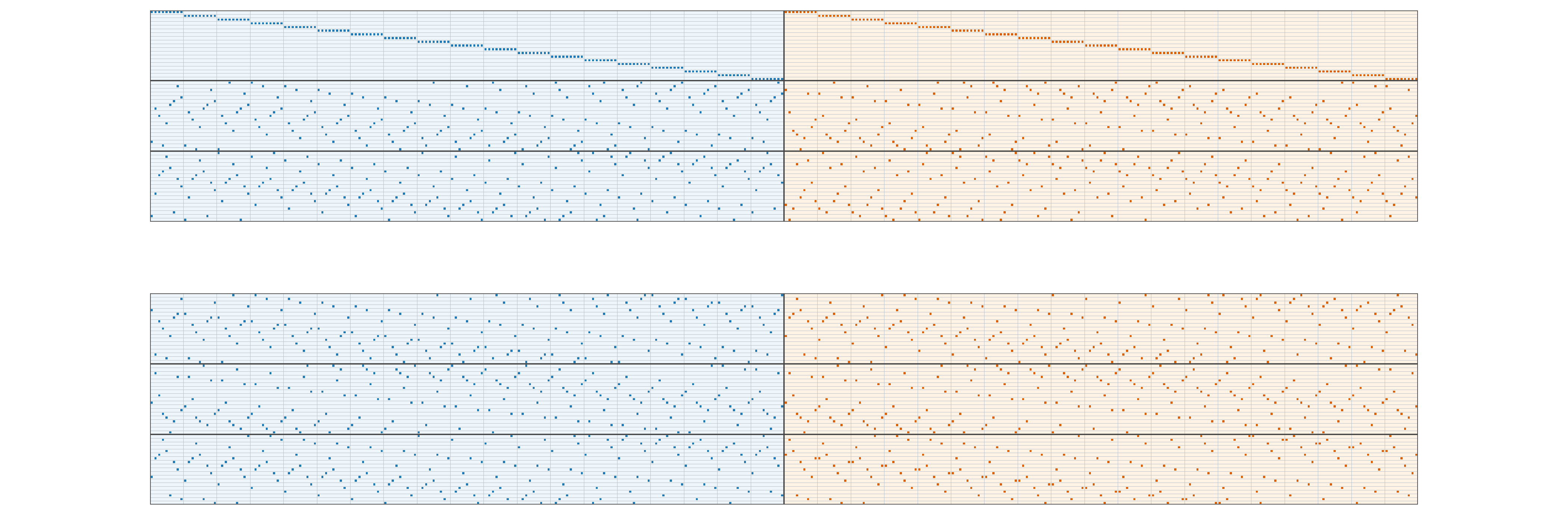
Each nonzero base edge is replaced by a \(101\times101\) circulant permutation matrix. A lifted column is written as \(101j+s\), where \(j\) is the base column and \(0\le s<101\). For a base edge \((i,j)\) with CPM shift \(\sigma(i,j)\), lifted row \(101i+r\) has a nonzero entry in column \(101j+((r+\sigma(i,j))\bmod101)\).
The shift values are generated from the affine form \[ \begin{aligned}&\sigma_S(g,b,h;t)\\&\quad=c_{S,g,b,h}+d_{S,g,b,h}t \pmod{101}.\end{aligned} \] There are 108 pairs of affine coefficients for each CSS side, row group, branch, and \(h\in M\). Expanding this affine description over all \(t\in\mathbb F_{19}\) gives 2052 base-edge CPM shifts. The human-readable coefficient page is rate23_qldpc_2606_27130_lift_coefficients.html.
| Lift degree | \(P=101\) |
|---|---|
| Lifted length and checks | \(n=34542\), with 5757 \(X\)-checks and 5757 \(Z\)-checks. |
| Computed ranks | \(\operatorname{rank}H_X=\operatorname{rank}H_Z=5755\), giving \(k=23032\). |
| Regularity | All rows have weight 18 and all columns have weight 3 on both CSS sides. |
| CSS orthogonality | No bad \(X\)-\(Z\) row pair was found in the expanded binary matrices; the maximum cross overlap is 2. |
| Same-side Tanner girth | No same-side 6-cycle remains after lifting, and an explicit same-side 8-cycle is present; hence the same-side Tanner girth is 8. |
The construction used an iterative procedure. A CPM lift was constructed, decoded in finite-length experiments, and then any observed low-weight logical support was projected from lifted columns to base columns. The projected supports, together with supports obtained from the affine symmetries of the finite-field base, were added as forbidden base supports for the next lift search.
The public data contain 110 observed logical-support entries. Projection to base columns, duplicate removal, and affine-orbit expansion give 285 forbidden base supports. For each forbidden support, the verification enumerates the pairing constraints on CPM sheet variables that would make the support compatible with the lifted code. In this instance, no forbidden support has a compatible lifted realization, and no compatible pairing pattern remains.
Version 2 proves \(d=18\). It also proves \(d\le18\) for every CSS-orthogonal, affine-in-\(t\) CPM lift of this same base when the lift degree is prime and greater than 19.
The original archive records a weight-310 nontrivial logical representative from decoder-failure analysis and subsequent syndrome-solve and weight-reduction checks. Its \(d\le310\) bound has been superseded by the exact result above.
The file weight310_logical_structure_search.json records the structural summary used for this upper-bound discussion.
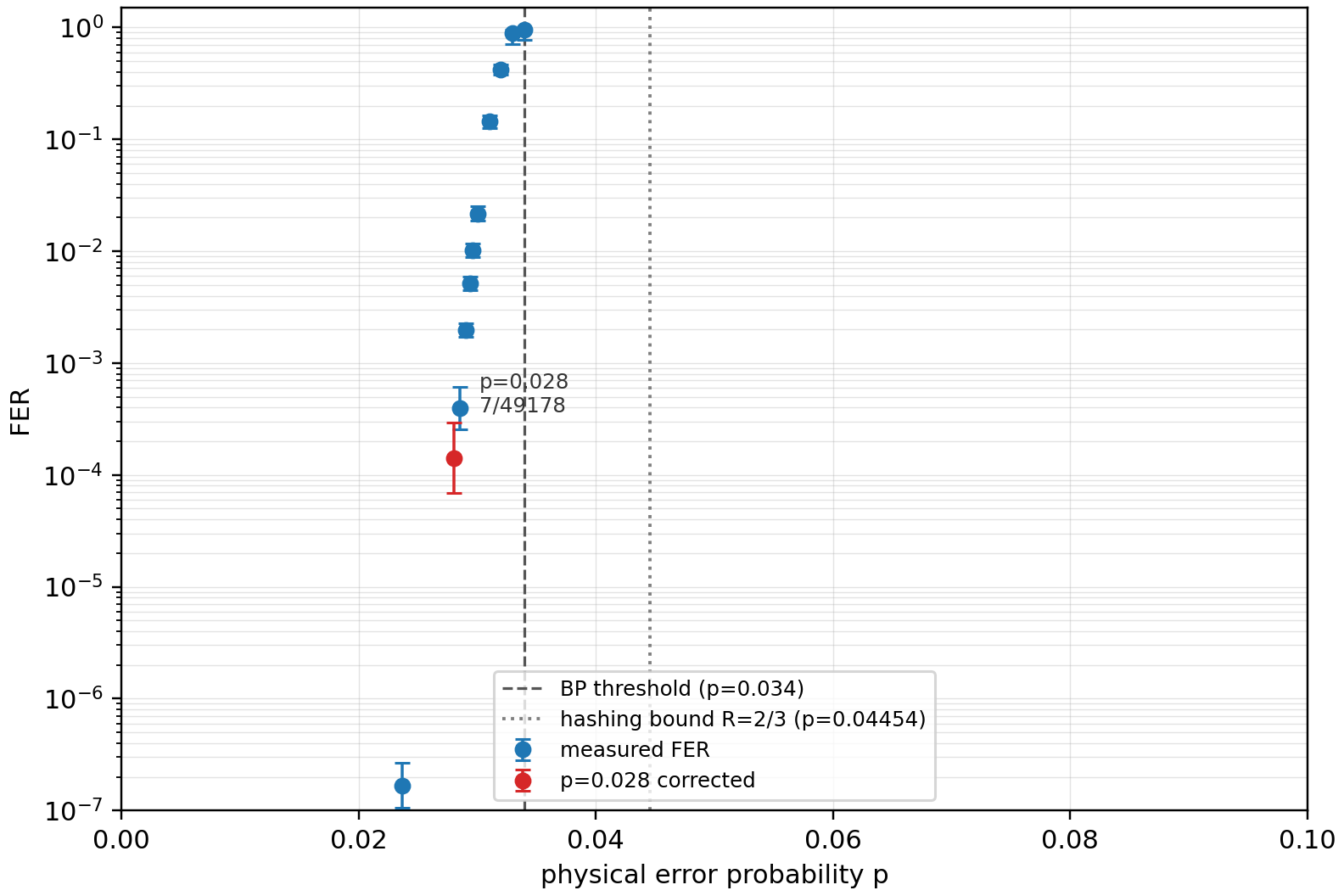
The FER figure used with this construction is provided as PDF and PNG.