Pair-Partition Constructions for CPM- and GPM-Based Quantum LDPC Codes
arXiv:2607.14091 Software on GitHub SHA-256 manifest Girth-8 seed randomization Rank-bound tip Girth-8 tip Citation
This webpage is the authoritative catalogue for the reported code parameters, fixed instances, and verification records. The GitHub repository is maintained separately for construction, search, and verification software; any instance files kept there serve only as program inputs and regression fixtures.
Girth-Preserving Randomization from the [[472,122,16]] Seed
We randomized the exponent labels of the published girth-8 \(\lbrack\!\lbrack472,122,16\rbrack\!\rbrack\) CPM-PP code while fixing \((J,L,P)=(3,8,59)\), the pair-partition array, CSS orthogonality, both Tanner girths, and the binary ranks. All five accepted codes have \(n=472\), \(k=122\), \(\operatorname{rank}H_X= \operatorname{rank}H_Z=175\), and actual rate \(122/472\simeq0.2585\). Minimum distance was not imposed during the walk and therefore changes among the samples.
Construction method
-
Keep the seed's pair-partition array \(M\). With
\(x=(\operatorname{vec}E,\operatorname{vec}D)\in\mathbb F_{59}^{48}\),
every pair \(\{u,v\}\in M_{ir}\) imposes
\[ d_{r,u}-e_{i,u}=d_{r,v}-e_{i,v}\pmod{59}. \]These equations are exactly the CPM pair-overlap conditions that imply \(H_XH_Z^{\mathsf T}=0\).
- Compute a basis \(B\) of \(\ker A_M\) and write every admissible exponent assignment as \(x=Bc\). For this seed the equation rank is 29 and the solution-space dimension is 19.
-
Project the nonzero-exponent, mixed-distinctness, lifted 4-cycle, and
lifted 6-cycle voltage tests into coefficient space. After duplicate
forms are merged, the valid region is
\[ \mathcal V=\{c\in\mathbb F_{59}^{19}:\ell_s(c)\ne0 \text{ for all }s=1,\ldots,192\}. \]The raw tests comprise 168 same-side 4-cycle forms, 672 same-side 6-cycle forms, and 54 mixed-distinctness forms.
- Start from the certified seed coefficient vector. At each zero-walk step, choose one coefficient and a new value uniformly at random; accept the proposal only if every projected form remains nonzero. Each reported sample used 400 accepted steps and an independent random seed.
- Expand \(E\) and \(D\) into 59-by-59 circulant permutation matrices, then directly recheck regularity, CSS orthogonality, ranks, and exact Tanner girth 8 on both sides. Finally, certify \(d_X\) and \(d_Z\) with complete connected-support quotient searches and explicit non-stabilizer zero-syndrome witnesses.
This is a structured walk inside the fixed pair-partition CPM solution space, not an unrestricted edge-swap randomization of arbitrary CSS matrices. Preserving \((J,L)\), girth, length, dimension, and CSS orthogonality does not preserve distance or finite-length decoder behavior; distance screening must be rerun after randomization.
Exact distances
| code | \(d_X\) | \(d_Z\) | \(d\) | files |
|---|---|---|---|---|
| original seed | 16 | 16 | 16 | CPM |
| rand101 | 14 | 14 | 14 | CPMmetadata |
| rand202 | 12 | 12 | 12 | CPMmetadata |
| rand303 | 14 | 14 | 14 | CPMmetadata |
| rand404 | 8 | 8 | 8 | CPMmetadata |
| rand505 | 14 | 14 | 14 | CPMmetadata |
Exact distance is invariant under stabilizer-code isomorphism. Because every randomized sample has \(d\lt16\), none is permutation-equivalent to the original seed code.
reproducibility note exact-distance summary and witnesses construction and randomization script SHA-256
Jong Yeon Lee: 19 contributed CPM-PP codes
The 19 instances below were supplied by Jong Yeon Lee. The construction parameters, CSS commutation, dimensions, regularities, pair-partition structure, and both Tanner girths of all downloadable instances were independently checked for this webpage. Unless an independent distance certificate is linked, the minimum-distance values below are reported as supplied by the contributor. They are therefore kept separate from the independently certified exact-distance catalogue.
| instance | parameters | girth | (J,L,P) | distance status | file |
|---|---|---|---|---|---|
PPS104 | [[104,30,8]] | (6,6) | (3,8,13) | reported exact | CPM |
PPS110A | [[110,8,12]] | (6,6) | (5,10,11) | reported exact | CPM |
PPS110B | [[110,8,12]] | (6,6) | (5,10,11) | reported exact | CPM |
PPS110C | [[110,8,12]] | (6,6) | (5,10,11) | reported exact | CPM |
PPS136 | [[136,38,8]] | (6,6) | (3,8,17) | reported exact | CPM |
PPS152 | [[152,42,8]] | (6,6) | (3,8,19) | reported exact | CPM |
PPS170 | [[170,8,20]] | (6,6) | (5,10,17) | reported exact | CPM |
PPS184 | [[184,50,10]] | (6,6) | (3,8,23) | reported exact | CPM |
PPS190 | [[190,8,18]] | (6,6) | (5,10,19) | reported exact | CPM |
PPS228 | [[228,82,12]] | (6,6) | (4,12,19) | reported exact | CPM |
PPS232 | [[232,62,12]] | (6,6) | (3,8,29) | reported exact | CPM |
PPS248 | [[248,66,12]] | (8,8) | (3,8,31) | reported exact | CPM |
PPS276 | [[276,98,14]] | (6,6) | (4,12,23) | reported exact | CPM |
PPS296 | [[296,78,12]] | (8,8) | (3,8,37) | reported exact | CPM |
PP59 | [[472,122,16]] | (8,8) | (3,8,59) | reported exact | CPM |
PP61 | [[488,126,16]] | (8,8) | (3,8,61) | reported exact | CPM |
PP37J5L20 | [[740,378,d]] | (6,6) | (5,20,37) | 16 ≤ d ≤ 20; lower bound reported, upper bound independently verified | CPMweight-20 audit |
PP113 | [[904,230,20]] | (8,8) | (3,8,113) | reported exact | CPM |
PP53J4L18 | [[954,536,14]] | (6,6) | (4,18,53) | reported exact | CPM |
machine-readable catalogue code list and comparison notes construction verifier (Python source) provenance and verification note contributor SHA-256 list
Nishad Maskara: three contributed check-weight-eight codes
The three instances below were supplied by Nishad Maskara, and their construction parameters and exact distances were independently verified.
Small-Blocklength \((J,L)=(3,8)\) Update
(J,L,P)=(3,8,29), girth 6, rate 0.267.
The exact-distance certificate completely excludes nontrivial logical supports through weight 10 on both CSS sides. All kernel vectors have even weight, and verified non-stabilizer logical representatives of weight 12 occur on both sides; hence \(d_X=d_Z=12\).
Relative to the small GPM-PP reference \([[200,54,10]]\), this CPM-PP code is 16% longer, encodes 14.8% more qubits, keeps essentially the same rate (0.267 versus 0.270), and improves the distance by 20%. It is a CPM-PP comparison point, not a new GPM-PP construction.
source NPZ certificate index certificate bundle verification note
Three independently seeded constrained CPM-PP heat-bath runs sampled 500,000 exponent assignments at \(P=29\). Of these, 50,562 passed the no-4-cycle and dimension filters, but none passed the complete connected-support exclusion through weight 12. Most survivors (48,464) were rejected by a weight-12 logical.
This is an empirical null result within the sampled constrained CPM-PP family. It is neither an impossibility theorem nor a search of the broader GPM-PP ensemble.
Exact \((J,L)=(3,8)\) Frontier Additions
Six exact-distance points extend the discrete \((n,k,d)\) tradeoff catalogue. Four use genuinely noncyclic regular permutation groups; the two coprime cyclic products are permutation-equivalent to composite CPM lifts. All six remain in the complete table below. The figures display only points that are nondominated for their plotted axes within each \((J,L)\) family.
| code | regular group | classification | files |
|---|---|---|---|
| [[264,70,12]] | \(C_3\times C_{11}\cong C_{33}\) | cyclic-equivalent | NPZexact certificate |
| [[280,74,12]] | \(C_5\times C_7\cong C_{35}\) | cyclic-equivalent | NPZexact certificate |
| [[288,76,12]] | \(S_3\times C_3\times C_2\) | noncyclic GPM-PP | NPZexact certificate |
| [[336,88,12]] | \(S_3\times C_7\) | noncyclic GPM-PP | NPZexact certificate |
| [[392,102,14]] | \(C_7\times C_7\) | noncyclic GPM-PP | NPZexact certificate |
| [[432,112,14]] | \(S_3\times C_3\times C_3\) | noncyclic GPM-PP | NPZexact certificate |
Exact APM-PP Additions
Two audited affine-permutation-matrix pair-partition codes are now part of the complete catalogue. The figures recompute Pareto membership from every catalogue row: only nondominated points appear, while both APM-PP codes remain in the table.
(J,L,P)=(4,16,36), APM-PP, girth 6, rate 0.510.
Complete APM orbit-root searches exclude logicals through weight 10 on both CSS sides. The all-one row-space certificate excludes odd weights, and verified weight-12 logicals give \(d_X=d_Z=d=12\). This point is on the \((4,16)\) \((n,d)\) Pareto frontier and replaces the longer \([[752,382,12]]\) graph-only point in that plot.
(J,L,P)=(3,8,128), APM-PP, girth 6, rate 0.254.
Exhaustive search gives \(18\le d_X\le20\) and \(d_Z=18\), hence the quantum distance is exactly \(d=18\). It stays in the complete table but is not plotted: the shorter \([[584,150,18]]\) code dominates it in the \((3,8)\) \((n,d)\) plot.
Recent Certified PP Additions (August 2026)
This release adds completed PP artifacts produced after the previous APM-PP update. Exact-distance codes enter the catalogue; alternative AOD and computation-oriented presentations are linked without being counted as new binary equivalence classes. The already published [[576,294,12]] package is not duplicated, and unfinished searches are excluded.
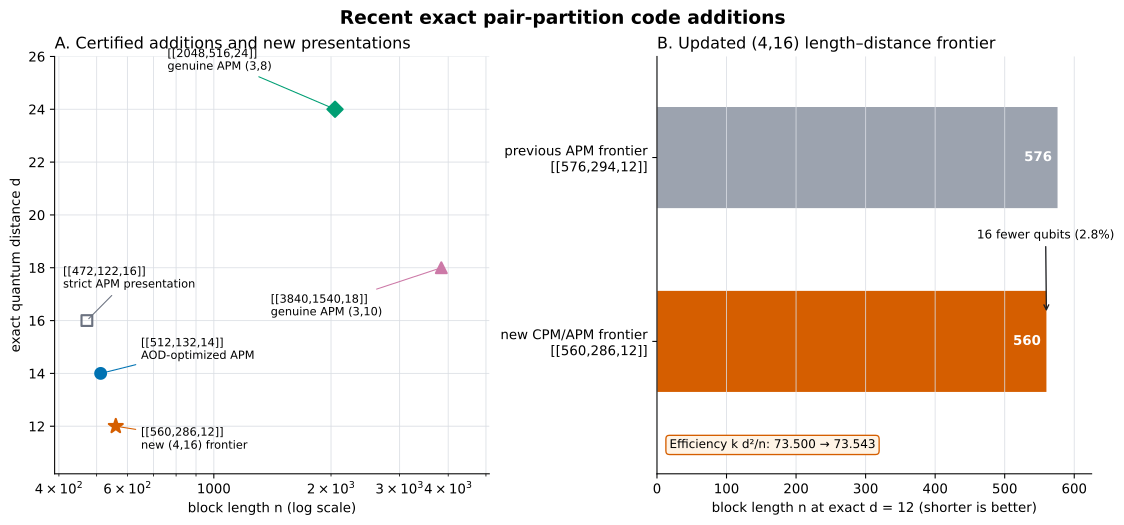
(J,L,P)=(4,16,35), CPM-PP/APM-PP, exact dX=dZ=12.
This is the updated (4,16) length-distance frontier: it replaces [[576,294,12]] at exact distance 12, using 16 fewer qubits.
(J,L,P)=(3,8,64), APM-PP, girth 8, exact dX=dZ=14.
The absolute AOD schedule reduces distinct cyclic shifts from (24,27) to (17,17). A separate relative-schedule realization is provided under its own objective.
absolute-AOD NPZabsolute certificaterelative-AOD NPZrelative certificate
(J,L,P)=(3,8,256), genuine APM-PP, girth 8, exact d=24.
The construction audit excludes CPM gauge reduction. A weight-24 X logical and independent lower certificates establish the quantum distance.
(J,L,P)=(3,10,384), genuine APM-PP, girth 6, exact dX=dZ=18.
Construction and distance audits, complete lower searches through weight 16, and explicit weight-18 logicals are included.
(J,L,P)=(3,8,59), strict all-nonzero APM-PP, girth 8.
An explicit qubit permutation transfers the existing exact-distance certificate. This is a computation-oriented presentation, not a new binary equivalence class.
Sparse APM-PP representation with computation artifacts; the current source record supplies only d<=20.
It is therefore published as a distance-pending representation and is deliberately omitted from the exact-distance catalogue.

Promising Lower-Bound and Distance-Pending Candidates
These fixed PP instances include certified lower-bound improvements for the \((J,L)=(4,12)\) family and two minimal-twist \((3,8)\) APM-PP codes. Their exact distances are still being determined, so every graph places each such point at its proved lower bound. The \((4,16)\) GPM-PP entry below is different: its distance is still pending, and its open plot marker at \(d_{\rm target}=18\) is a search target, not a certified lower bound.
(J,L,P)=(3,8,192), minimal-twist Twisted APM-PP, girth 8, rate 0.253.
Complete exclusion through weight 24 on both CSS sides, together with the all-one row-space parity certificate, gives d≥26. The 48 affine blocks use only slopes 1 and 97; 32 blocks are twisted and the remaining 16 are ordinary CPM shifts. This Okada construction is a Z2-twisted double cover of a valid [[768,196]] CPM-PP code and improves the certified \((3,8)\) length-distance frontier. No matching upper-bound logical is included.
READMEAPM-PP inputX checksZ checksverifierX lower certificateZ lower certificatesource bundleSHA-256
(J,L,P)=(3,8,288), minimal-twist APM-PP, girth 8, rate 0.252.
Complete exclusion through weight 24 on both CSS sides, together with the all-one row-space parity certificate, gives d≥26. The 48 affine blocks use only slopes 1 and 145; 20 blocks are twisted and the remaining 28 are ordinary CPM shifts. No matching upper-bound logical is included.
READMEAPM-PP inputX checksZ checksverifierX lower certificateZ lower certificatesource bundleSHA-256
(J,L,P)=(4,12,73), girth 6, rate 0.340.
Complete exclusion through weight 18; the weight-20 search is continuing.
(J,L,P)=(4,12,79), girth 6, rate 0.340.
Complete exclusion through weight 20; the weight-22 search is continuing.
(J,L,P)=(4,12,89), girth 6, rate 0.339.
Complete exclusion through weight 24 on both CSS sides; the even-weight certificate gives d≥26, while verified weight-84 logicals give d≤84.
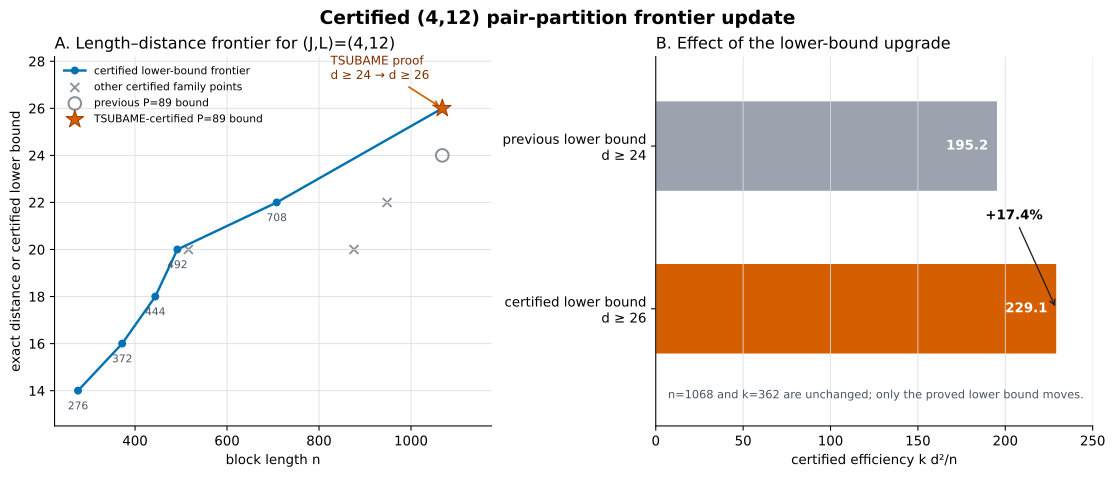
d≥24 to d≥26. It remains on
both the length–distance and k d²/n frontiers; the latter
certified efficiency increases by 17.4%.
CPMverification indexlower-bound auditcertificate bundleSHA-256
(J,L,P)=(4,16,49), \(C_7\times C_7\) GPM-PP, girth 6, rate 0.508.
Exact exclusion through weight 17 is complete for 9 of 16 symmetry-representative roots on each CSS side. No weight-at-most-17 witness was found in the completed shards, but the unfinished roots prevent a global lower-bound claim. A verified X-type logical gives \(d\le78\).
GPM-PP NPZconstruction auditpartial distance statusweight-78 logicalSHA-256
Distance versus Block Length by \((J,L)\)
The plot contains only the \((n,d)\)-nondominated points within each \((J,L)\) family. It derives those points from the complete catalogue and the girth-4 graph-only set; non-frontier codes remain available in the complete table below. Choose a \((J,L)\) family, then point to or select a code to display its construction parameters and data files. Pointing to a code highlights only its \((J,L)\) family and the corresponding \(d=\delta_{J,L}n\) line. Exact-distance points have both a complete lower-bound search and a matching logical vector. Promising lower-bound candidates are plotted at their certified lower bounds, not at their known upper bounds. The open \((784,18)\) marker is explicitly provisional: 18 is the current search target and is not a distance claim. Starting at the origin \((0,0)\), the dashed line for each family is \(d=\delta_{J,L}n\), where \(\delta_{J,L}\) is the typical relative-distance baseline of the corresponding regular one-edge LDPC configuration ensemble.
Catalogue of Verified Codes and Promising Candidates
The yellow rows are the six new GPM-PP search additions; two are cyclic-equivalent composite lifts and four use genuinely noncyclic groups. The purple rows are exact-distance APM-PP additions. Only their nondominated members appear in the automatically generated figures; every certified point remains in this table. The green row gives a girth-6 small-lift frontier point found by searching prime lift sizes in increasing order. All girth-4 instances are omitted For every displayed point, both CSS matrices and the positive encoded dimension were independently checked. Exact-distance rows additionally have a matching verified logical vector; rows marked with \(d\geq d_0\) state only the independently certified lower bound \(d_0\). The girth is shown separately for each row. The displayed \(P\) for \(\lbrack\!\lbrack 1414,812,12\rbrack\!\rbrack\) is the smallest found in the sampled search, not a proof of global optimality over every PP array. The remaining rows agree with Table I of the current paper. Among those paper codes, the highlighted \(\lbrack\!\lbrack 472,122,16\rbrack\!\rbrack\), \(\lbrack\!\lbrack 584,150,18\rbrack\!\rbrack\), \(\lbrack\!\lbrack 1112,282,20\rbrack\!\rbrack\), \(\lbrack\!\lbrack 1336,338,22\rbrack\!\rbrack\), \(\lbrack\!\lbrack 1630,656,20\rbrack\!\rbrack\), \(\lbrack\!\lbrack 1784,450,24\rbrack\!\rbrack\), and \(\lbrack\!\lbrack 2230,896,24\rbrack\!\rbrack\) codes have girth 8 on both sides. The first three codes were provided by Nishad Maskara and independently verified for this work.
Every catalogue row now links a fixed-input certificate bundle, a verification index, and SHA-256 checksums. The exact-distance label is used only when the lower-bound payload and an explicit logical vector have both passed independent verification.
complete row-by-row audit (JSON) audit table (Markdown) master manifest
Worked Construction Example
The following steps trace the construction of the published \(\lbrack\!\lbrack 472,122,14\rbrack\!\rbrack\) instance. They show how a pair-partition design becomes two binary CSS check matrices and how the stated code parameters are then verified.
- Choose the block parameters. Set \(J=3\), \(L=8\), and \(P=59\). Thus each CSS check matrix will have \(JP=177\) rows and \(LP=472\) columns, with column weight 3 and row weight 8.
-
Generate and screen the pair-partition array M.
Each of the nine cells \(M_{ij}\) is a perfect matching of
\(\{0,\ldots,7\}\). For example,
\[ M_{00}=\bigl\{\{0,5\},\{1,7\},\{2,4\},\{3,6\}\bigr\}. \]The matchings are arranged so that no unordered pair is reused within an array row or column. The associated pairing graphs are checked before any exponent search; a design that already forces a forbidden short cycle is discarded here.
-
Form the linear system from M.
Write \(E=(e_{i,\ell})\) and \(D=(d_{j,\ell})\). Every pair
\(\{u,v\}\) in \(M_{ij}\) gives
\[ d_{j,u}-e_{i,u}\equiv d_{j,v}-e_{i,v}\pmod P. \]Here there are 48 exponent variables and 36 raw equations. The pair \(\{0,5\}\) in \(M_{00}\), for example, gives\[ \begin{aligned} d_{0,0}-e_{0,0} &\equiv d_{0,5}-e_{0,5}\pmod{59},\\ 11-53 &\equiv 2-44 \equiv 17\pmod{59}. \end{aligned} \]Thus the published exponents satisfy this row of \(A_Mx=0\).
-
Solve over \(\mathbb F_{59}\) and screen the exponents.
One surviving solution is
\[ \begin{aligned} E&=\begin{bmatrix} 53&43&36&43&56&44&49&9\\ 56&8&52&24&2&45&29&47\\ 5&14&44&22&23&39&33&32 \end{bmatrix},\\[4pt] D&=\begin{bmatrix} 11&36&9&51&29&2&57&2\\ 9&56&3&11&12&57&16&36\\ 51&48&18&43&56&26&54&7 \end{bmatrix}. \end{aligned} \]Candidates that fail the same-side CPM cycle tests or reproduce a stored low-weight logical pattern are rejected. The stored patterns accelerate construction; they are not used as a distance proof.
-
Lift the exponents to CPMs and verify the CSS code.
Replace every entry of \(E\) and \(D\) by the
corresponding 59-by-59 circulant permutation matrix. Direct checks give
\(H_XH_Z^{\mathsf T}=0\), girth 6 on both sides, and
\(\operatorname{rank}(H_X)=\operatorname{rank}(H_Z)=175\). Hence
\[ n=8\cdot59=472,\qquad k=472-175-175=122. \]
- Certify the distance. Complete searches find no non-stabilizer zero-syndrome vector through weight 12 on either CSS side. All such vectors have even weight, and explicit weight-14 representatives are found on both sides. Therefore the exact distance is \(d=14\).
M, E, and D construction audit X lower-bound record Z lower-bound record
Data Format
CPM exponent files
A .cpm file starts with CPM_CSS_V1. The next line gives
the instance name, lift size P, row weight L, and the two
block-row counts. The following J rows are the exponent array
e for H_X, and the next J rows are the exponent array
d for H_Z.
CPM_CSS_V1
qc_590_240_12 59 10 3 3
e_00 e_01 ... e_09
e_10 e_11 ... e_19
e_20 e_21 ... e_29
d_00 d_01 ... d_09
d_10 d_11 ... d_19
d_20 d_21 ... d_29
Common format
The same .cpm format is used for both column-weight-three
and column-weight-four instances.
J=3files contain threeH_Xrows and threeH_Zrows.J=4files contain fourH_Xrows and fourH_Zrows.
The three files contributed by Nishad Maskara are distributed in
NumPy .npz format and contain the two binary check
matrices together with the supplied logical-vector data.
Distance Certification Summary
| instance | lower-bound check | upper-bound check |
|---|---|---|
| [[232,62,12]] | complete exclusion through weight 10 on both CSS sides | non-stabilizer representatives of weight 12 on both CSS sides |
| [[248,66,12]] | complete exclusion through weight 10 on both CSS sides | non-stabilizer representatives of weight 12 on both CSS sides |
| [[264,70,12]] | full-root connected-support exclusion through weight 10 on both CSS sides, plus even-kernel parity | independently verified weight-12 logical representatives on both CSS sides |
| [[280,74,12]] | full-root connected-support exclusion through weight 10 on both CSS sides, plus even-kernel parity | independently verified weight-12 logical representatives on both CSS sides |
| [[288,76,12]] | full-root connected-support exclusion through weight 10 on both CSS sides, plus even-kernel parity | independently verified weight-12 logical representatives on both CSS sides |
| [[296,78,12]] | complete exclusion through weight 10 on both CSS sides | non-stabilizer representatives of weight 12 on both CSS sides |
| [[336,88,12]] | full-root connected-support exclusion through weight 10 on both CSS sides, plus even-kernel parity | independently verified weight-12 logical representatives on both CSS sides |
| [[392,102,14]] | full-root connected-support exclusion through weight 12 on both CSS sides, plus even-kernel parity | independently verified weight-14 logical representatives on both CSS sides |
| [[432,112,14]] | full-root connected-support exclusion through weight 12 on both CSS sides, plus even-kernel parity | independently verified weight-14 logical representatives on both CSS sides |
| [[472,122,16]] (girth 8) | complete exclusion through weight 14 on both CSS sides | non-stabilizer representatives of weight 16 on both CSS sides |
| [[472,122,14]] | complete exclusion through weight 12, plus even-weight property | non-stabilizer representatives of weight 14 |
| [[488,126,14]] | complete exclusion through weight 12, plus even-weight property | non-stabilizer representatives of weight 14 |
| [[584,150,18]] (girth 8) | complete exclusion through weight 16 on both CSS sides | non-stabilizer representatives of weight 18 on both CSS sides |
| [[1112,282,20]] (girth 8) | complete exclusion through weight 18 on both CSS sides | non-stabilizer representative of weight 20 |
| [[1336,338,22]] (girth 8) | complete exclusion through weight 20 on both CSS sides | non-stabilizer representative of weight 22 |
| [[1784,450,24]] (girth 8) | complete X-side exclusion through weight 22, transferred by a verified X/Z coordinate involution | non-stabilizer representatives of weight 24 on both CSS sides |
| [[470,192,12]] | complete exclusion through weight 10 on both CSS sides | verified weight-12 X-logical representative; hence the minimum distance is exactly 12 |
| [[530,216,12]] | complete exclusion through weight 10, plus even-weight property | non-stabilizer representatives of weight 12 |
| [[590,240,12]] | complete exclusion through weight 10, plus even-weight property | non-stabilizer representatives of weight 12 |
| [[710,288,14]] | complete exclusion through weight 12 on both CSS sides | verified weight-14 logical representatives on both CSS sides; hence the minimum distance is exactly 14 |
| [[970,392,16]] | complete exclusion through weight 14 on both CSS sides | verified weight-16 logical representatives on both CSS sides; hence the minimum distance is exactly 16 |
| [[1390,560,18]] | complete exclusion through weight 16 on both CSS sides | verified weight-18 logical representatives on both CSS sides; hence the minimum distance is exactly 18 |
| [[1490,600,18]] | complete exclusion through weight 16 on both CSS sides | verified weight-18 logical representatives on both CSS sides; hence the minimum distance is exactly 18 |
| [[1630,656,20]] (girth 8) | 88 verified first-branch certificates on each CSS side completely exclude weights through 18 | verified weight-20 logical representatives on both CSS sides; hence the minimum distance is exactly 20 |
| [[2110,848,22]] | 90 verified first-branch certificates exclude X-type logical vectors through weight 20; a verified involutive X/Z coordinate swap transfers the exclusion to the Z side | independently verified permanent kernel vectors of weight 22 on both CSS sides |
| [[1356,682,14]] | complete exclusion through weight 12 on both CSS sides | verified weight-14 X-logical representative; hence the minimum distance is exactly 14 |
| [[1524,766,14]] | complete exclusion through weight 12, plus even-weight property | non-stabilizer representatives of weight 14 |
| [[2004,1006,16]] | complete exclusion through weight 14 on both CSS sides, repeated by independent runs | independently verified weight-16 logical representatives on both CSS sides; hence the minimum distance is exactly 16 |
| [[2676,1342,18]] | 15,708 verified X-side and 15,828 verified Z-side certificates completely exclude logical vectors through weight 16, with no timeouts | independently verified weight-18 X-logical representative; hence the minimum distance is exactly 18 |
| [[3122,1788,16]] | complete exclusion through weight 14, plus even-weight property | non-stabilizer representatives of weight 16 |
| [[276,98,14]] | complete exclusion through weight 12, plus row-family parity | non-stabilizer representatives of weight 14 |
| [[372,130,16]] | complete exclusion through weight 14, plus row-family parity | non-stabilizer representatives of weight 16 |
| [[444,154,18]] | 124 verified X-side and 128 verified Z-side first-branch certificates completely exclude weights through 16; direct row-space calculations exclude odd zero-syndrome weights | verified weight-18 logical representatives on both CSS sides; hence the minimum distance is exactly 18 |
| [[492,170,20]] | 1,362 independently verified hybrid second- and third-branch certificates completely exclude X-type logical vectors through weight 18; the even-weight property and a verified X/Z involution transfer the bound to both CSS sides | independently verified weight-20 logical representatives on both CSS sides; hence the minimum distance is exactly 20 |
| [[516,178,20]] | 14,148 independently verified X-side third-branch certificates completely exclude weights through 18; a verified CPM-affine X/Z coordinate isomorphism transfers the bound to the Z side | independently verified X-type logical representative of weight 20; hence the minimum distance is exactly 20 |
| [[708,242,22]] | an independently re-audited multilevel X-side certificate chain excludes weights through 20; a verified CPM-affine X/Z isomorphism transfers the bound to the Z side | independently verified weight-22 logical representatives on both CSS sides; hence the minimum distance is exactly 22 |
| [[876,298,d≥20]] | a complete X-side certificate audit excludes weights through 18; the even-weight property and a verified CPM-affine X/Z isomorphism transfer the bound to both CSS sides | verified logical representatives give d ≤ 76; the weight-20 search is continuing |
| [[948,322,d≥22]] | a complete multilevel X-side certificate chain excludes weights through 20; a verified CPM-affine X/Z isomorphism transfers the bound to the Z side | verified logical representatives give d ≤ 80; the weight-22 search is continuing |
| [[1068,362,d≥26]] | all deterministic X-side QC-root shards exclude weights through 24; the even-weight certificate and a verified CPM-affine X/Z isomorphism give the bound d≥26 on both CSS sides | independently verified weight-84 logical representatives on both CSS sides give d ≤ 84 |
| [[518,228,16]] | complete exclusion through weight 14, plus row-family parity | non-stabilizer representatives of weight 16 |
| [[574,252,18]] | complete exclusion through weight 16, plus row-family parity | X-side non-stabilizer representative of weight 18 |
| [[848,430,18]] | complete exclusion through weight 16, plus row-family parity | X-side non-stabilizer representative of weight 18 |
| [[944,478,20]] | complete X-side exclusion through weight 18, plus verified CSS-side isometry | non-stabilizer representatives of weight 20 on both CSS sides |
CSS-Side Isometries and Fold-Transversal Clifford Gates
The public verification records for [[574,252,18]],
[[944,478,20]], [[516,178,20]], [[1784,450,24]], and
[[2110,848,22]] include Hamming-isometric coordinate
permutations \(\pi\) that exchange the two stabilizer row spaces:
Besides transferring distance information between the two CSS sides, this implies that the physical operation \(P_\pi H^{\otimes n}\) normalizes the stabilizer group. At the code level it therefore implements a logical Clifford using only single-qubit Hadamards and a qubit permutation: a Hadamard-type fold-transversal gate.
-
For
[[574,252,18]], the verified permutation is a fixed-point-free involution consisting of 287 disjoint transpositions (verification record). -
For
[[944,478,20]], it is likewise a fixed-point-free involution, consisting of 472 disjoint transpositions (verification record). -
For
[[516,178,20]], a verified CPM-affine coordinate permutation exchanges the two CSS sides and transfers the complete weight-18 exclusion (verification record). -
For
[[1784,450,24]], a verified involution exchanges the two row spaces and transfers the complete weight-22 exclusion from the X side to the Z side (verification record). -
For
[[2110,848,22]], a verified involutive CPM coordinate permutation exchanges all 633 rows on the two CSS sides and transfers the complete weight-20 exclusion (verification record).
This stabilizer-level result does not by itself identify the logical gate with independent Hadamards on all encoded qubits. The induced logical symplectic action may permute or mix logical degrees of freedom and must be computed separately. The physical cost and fault-tolerance implications of realizing the qubit permutation depend on the hardware connectivity and implementation.
Code Data Files
CPM exponent files
- qc_472_122_16_g8.cpm (girth-8 paper instance)
- qc_472_122_14.cpm
- qc_488_126_14.cpm
- qc_584_150_18_g8.cpm
- qc_1112_282_20_g8.cpm
- qc_1336_338_22_g8.cpm
- qc_1784_450_24_g8.cpm
- qc_530_216_12.cpm
- qc_590_240_12.cpm
- qc_1524_766_14.cpm
- qc_3122_1788_16.cpm
- qc_276_98_14_randomized_equivalent.cpm
- qc_372_130_16.cpm
- qc_518_228_16.cpm
- qc_574_252_18_randomized_equivalent.cpm
- qc_848_430_18.cpm
- qc_944_478_ge20_randomized_equivalent.cpm
- qc_444_154_ge18.cpm
- qc_516_178_20.cpm
- qc_2110_848_ge22.cpm
Additional girth-8 instance: source and verification records
Research Tip
Rank-deficient permanent bound
Let \(P\) be odd and let \(A(x)\in R_P^{J\times L}\) be a type-1 QC parity-check matrix with \(L\ge J+1\) (each entry is zero or a monomial), where \(R_P=\mathbb F_2[x]/(x^P-1)\). For every \(J\)-column set \(T\), take the maximal minor \(\det A_T(x)\) (equivalently, its permanent in characteristic two), and define
Let \(\mathcal M(A)\) be the binary span of all maximal-minor codewords obtained from \(J+1\) columns, together with all of their cyclic shifts. Then its dimension is exactly
Consequently, for a CSS pair with binary lifts \(H_X\) and \(H_Z\), where \(A_Z(x)\) has size \(J_Z\times L\) and \(g_Z=g(A_Z)\), the following is a sufficient condition:
The analogous statement with \(X\) and \(Z\) exchanged gives an upper bound on \(d_Z\). The familiar maximum-rank case for a fully populated CPM matrix is recovered by \(g_A(x)=x+1\).
Proof idea. Since \(P\) is odd, \(x^P-1\) is square-free. Chinese remaindering splits \(R_P\) into field components. On every full-row-rank component, the maximal-minor vectors span the entire kernel; on the remaining components they vanish. Summing the component dimensions gives the equality above. The CSS inequality then forces one of these vectors outside the opposite stabilizer row space, while its type-1 permanent construction has weight at most \((J+1)!\).
Scope: this is a sufficient bound for odd-lift, type-1 QC/CPM CSS codes, not a statement about arbitrary quantum LDPC codes. It is recorded here as a candidate extension for independent verification.
Practical Research Tip
Distance-aware girth-eight screening before exponent search
Fix a \(J\times J\) pair-partition array \(M\), and let \(A_M\) be its integer paired-difference matrix. On the rational PP solution space \(V_{\mathbb Q}(M)=\ker_{\mathbb Q}A_M\), every condition needed for mixed distinctness and Tanner girth at least eight is the nonvanishing of a homogeneous linear form: a mixed-collision form, a same-side four-cycle form, or a same-side six-cycle form. The total number before deduplication is
For each forbidden row vector \(f\), perform the exact rational rank test
Immediate rejection rule. If even one test fails, that collision, four-cycle, or six-cycle is forced by the PP equations for all but finitely many primes. Discard \(M\) before selecting a lift size, sampling exponents, expanding CPMs, or running a distance search. A larger generic lift will not repair the obstruction.
If every test passes, then all sufficiently large nonexceptional primes admit PP labels with girth at least eight, and a uniform PP solution has
The bound \(P>B_8(J,L)\) is only a coarse existence proof, not a recommended lift-size rule. For an actual prime \(P\), restrict the forbidden forms to a basis of the gauge quotient \(V(\mathbb F_P;M)/G\). Candidate screening then consists only of short dot products in \(q\) coordinates. Forms whose coefficient vectors are proportional define the same hyperplane; normalize them projectively and test each distinct hyperplane once. If \(N_{\mathrm{eff}}\) distinct hyperplanes remain, the same argument improves the finite-field bound to \(1-N_{\mathrm{eff}}/P\).
Add the minimum-distance obstruction test
The girth test is only the first filter. For a target \(D\), enumerate the finitely many connected symbolic X- and Z-kernel support templates of weight below \(D\). A template is harmless if it is a stabilizer; otherwise require at least one of its linear closure forms to be nonzero on \(V_{\mathbb Q}(M)\). If all such templates pass, the same hyperplane argument gives
outside a finite exceptional-prime set. Here \(N_{M,D}\) is the number of non-stabilizer templates retained in the union bound. This turns the structural prefilter into a genuine distance-and-girth existence test; the bound is conservative and does not replace a fixed-matrix exact-distance certificate.
Joint audit of the available girth-eight arrays
| Source array | (J,L) | Fixed code | Generic joint guarantee |
|---|---|---|---|
qc_472_122_16_g8 | \((3,8)\) | \(\lbrack\!\lbrack472,122,16\rbrack\!\rbrack\) | \(g\ge8,\ d\ge10\) |
qc_584_150_18_g8 | \((3,8)\) | \(\lbrack\!\lbrack584,150,18\rbrack\!\rbrack\) | \(g\ge8,\ d\ge10\) |
qc_1112_282_20_g8 | \((3,8)\) | \(\lbrack\!\lbrack1112,282,20\rbrack\!\rbrack\) | \(g\ge8,\ d\ge10\) |
qc_1336_338_22_g8 | \((3,8)\) | \(\lbrack\!\lbrack1336,338,22\rbrack\!\rbrack\) | \(g\ge8,\ d\ge10\) |
qc_1784_450_24_g8 | \((3,8)\) | \(\lbrack\!\lbrack1784,450,24\rbrack\!\rbrack\) | \(g\ge8,\ d\ge10\) |
qc_1630_656_20_g8 | \((3,10)\) | \(\lbrack\!\lbrack1630,656,20\rbrack\!\rbrack\) | \(g\ge8,\ d\ge12\) |
These six arrays, for which M is available, pass both CSS
sides of the exact rational symbolic-support audit. The fixed-code
distances in the third column remain the stronger claims at their
displayed lift sizes; the last column is the lift-independent generic
guarantee proved for the underlying pair-partition array.
Practical search order
- Reject pair arrays with a forced mixed collision, four-cycle, or six-cycle.
- Reject arrays with a generically forced non-stabilizer support below the target
D. - Reduce the remaining forms to quotient coordinates and deduplicate proportional hyperplanes.
- Expand CPMs only for survivors, then certify the exact finite-
Pdistance.
Structural prefilter audit
| PP family | Admissible arrays | Raw forms → distinct hyperplanes | Surviving q |
|---|---|---|---|
(3,8) | 9 / 9 | 894 → 192 | 6 |
(3,10) | 7 / 8 | 1,800 → 555 | 8 |
(3,12) | 1 / 2 | 3,171 → 1,875 | 10 |
(3,14) | 1 / 1 | 5,103 → 1,995 | 12 |
(4,12) | 2 / 3 | 11,592 → 1,218 | 8 |
(4,14) | 0 / 2 | 18,900 → — | — |
(4,16) | 0 / 1 | 28,768 → — | — |
Among the catalogue JSON records that include M, canonicalizing
pair order leaves 26 distinct arrays, of which 20 pass the exact rational
test. Every audited *_g8 array passes. The arrays underlying
qc_590_240_12, qc_1524_766_14,
qc_372_130_16, qc_518_228_16,
qc_574_252_18, and qc_848_430_18 fail because
their PP equations force at least one six-cycle form to vanish.
Projective deduplication is substantial: it reduces 894 raw forms to 192
hyperplanes for (3,8), and 11,592 to 1,218 for
(4,12). These rational counts are uniform across the
surviving arrays within each displayed family; reduction modulo a
particular prime can merge further hyperplanes.
Scope: the first test decides eventual structural feasibility, while the
template test adds a conservative generic distance target. The result
guarantees girth at least eight, not exactly eight, and does not transfer
the fixed code's exact distance to other lifts. Every selected
finite-P matrix must still be checked directly.
Memory Efficiency Relative to the Surface Code
Following the comparison used in Figure 1 (left) of arXiv:2607.27644, the vertical axis is \(\eta=kd^2/n\) and the horizontal axis is the block length \(n\). The rotated surface-code baseline is \(\eta=1\). Thus, a value \(\eta\) means that the PP code uses \(1/\eta\) as many data qubits as \(k\) independent distance-\(d\) surface-code patches under this comparison. Both axes are logarithmic. This data-qubit metric does not include syndrome ancillas and does not by itself predict circuit-level logical error rates. As in the distance plot, only the per-family Pareto frontier for the plotted axes is shown. The semi-transparent girth-4 frontier points appear only in the graph and are not included in the catalogue table.
Citation
@unpublished{okadaKasaiPairPartitionCPM2026,
  author = {Koki Okada and Kenta Kasai},
  title  = {Pair-Partition Constructions for CPM-Based Quantum LDPC Codes},
  note   = {arXiv:2607.14091},
  year   = {2026}
}